Thinset mortar modification
Ask whether the polymer additive for thinset is a redispersible powder, latex, or another form, and which solids content, pH and particle size the buyer named. Keep the mortar recipe decision with the buyer laboratory.
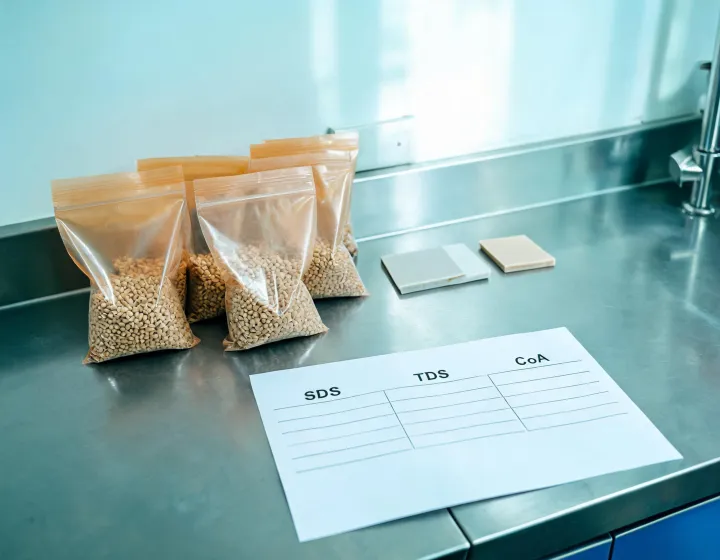
Document check before outreach
Polymer Additive Supplier Sourcing is an independent procurement desk for US compounders, mortar blenders and distributors. Name the additive grade, solids or loading window, quantity and US destination first. We then request comparable factory quotations. We do not sell from a warehouse, operate a compounding line, or publish a savings percentage.
Same-basis comparison
A unit price is not useful until grade, package net content, Incoterm, freight, duties and exclusions sit on one line. The sequence below is a buyer checklist. It is not a promise of inventory, authorization or lead time.
Record assay, purity or concentration, viscosity, melt flow method, density, moisture, molecular weight or solids content only when they matter to the process. A family name such as polymer additive does not replace the quoted grade or CAS number.
Request the current safety data sheet, technical data sheet and certificate of analysis format for the proposed lot. TSCA status for US supply, REACH statements, ISO quality-system evidence, GMP files and DOT or IMDG transport classification are verification questions, not credentials held by this desk.
State bag, carton, drum or IBC preference, net kilograms, palletization and labeling. Final storage, handling and carriage follow the exact SDS, UN number if assigned, flash point if reported, and carrier rules. This site does not issue mixing or operating instructions.
Place product subtotal, samples, testing, freight and destination charges on separate rows. An optional budget with currency and per-kg or whole-order basis is a planning input. High-end, mid-range, budget or undecided is a preference, not a rating of factories.
Paired use contexts
Each pair lists the extra fields that usually travel with that context. They are questions for the quotation, not performance claims about any factory or lot.
Ask whether the polymer additive for thinset is a redispersible powder, latex, or another form, and which solids content, pH and particle size the buyer named. Keep the mortar recipe decision with the buyer laboratory.
Treat kamal d. mehta magnetic polymer additive as a configuration label, not a person or an endorsed brand. Record loading target, carrier resin, melt flow, color and whether the CoA will report magnetic loading or only carrier assay.
For cyclopentane polymer additive wholesale, capture whether cyclopentane is the blowing context, a residual, or an additive carrier. Flash point, UN number and packaging become mandatory questions before freight can be compared.
Copy the downstream customer grade, package net weight and CoA layout. Do not average prices across two producers even when both call the product a polymer additive.
RFQ questions
Write the commercial grade, polymer family, concentration, color and any restricted additive list. If the grade is still open, say so instead of borrowing a competitor data sheet.
Powder, pellet, liquid, masterbatch or emulsion change packaging, drying and freight. Ask the supplier to confirm form, viscosity and melt flow against the requested window.
Keep SDS, TDS, CoA, TSCA, REACH and transport answers as open, accepted or not applicable. A document for a related grade is not evidence for the quoted product.
Identity, appearance, assay, viscosity, processing behavior or packaging can each be a pass/fail item. Laboratory and EHS decisions stay with qualified parties at the buyer site.
Read the polymer additive procurement brief before you send quantity and destination.
Include chemical name, CAS number where known, grade, purity or concentration, quantity, packaging, US destination and which SDS, TDS or CoA items still need confirmation. We will use that brief to contact possible factories and return comparable wholesale quotations.